Short Term Memory
Asks you to recall short-flight parameters accurately after a short delay.
Why recruiters care about it
Short Term Memory measures not just memorization, but whether you keep information clean under attention load.
Within Compass, memory consistency and delayed recall quality become visible here.
Step-by-step simulation flow
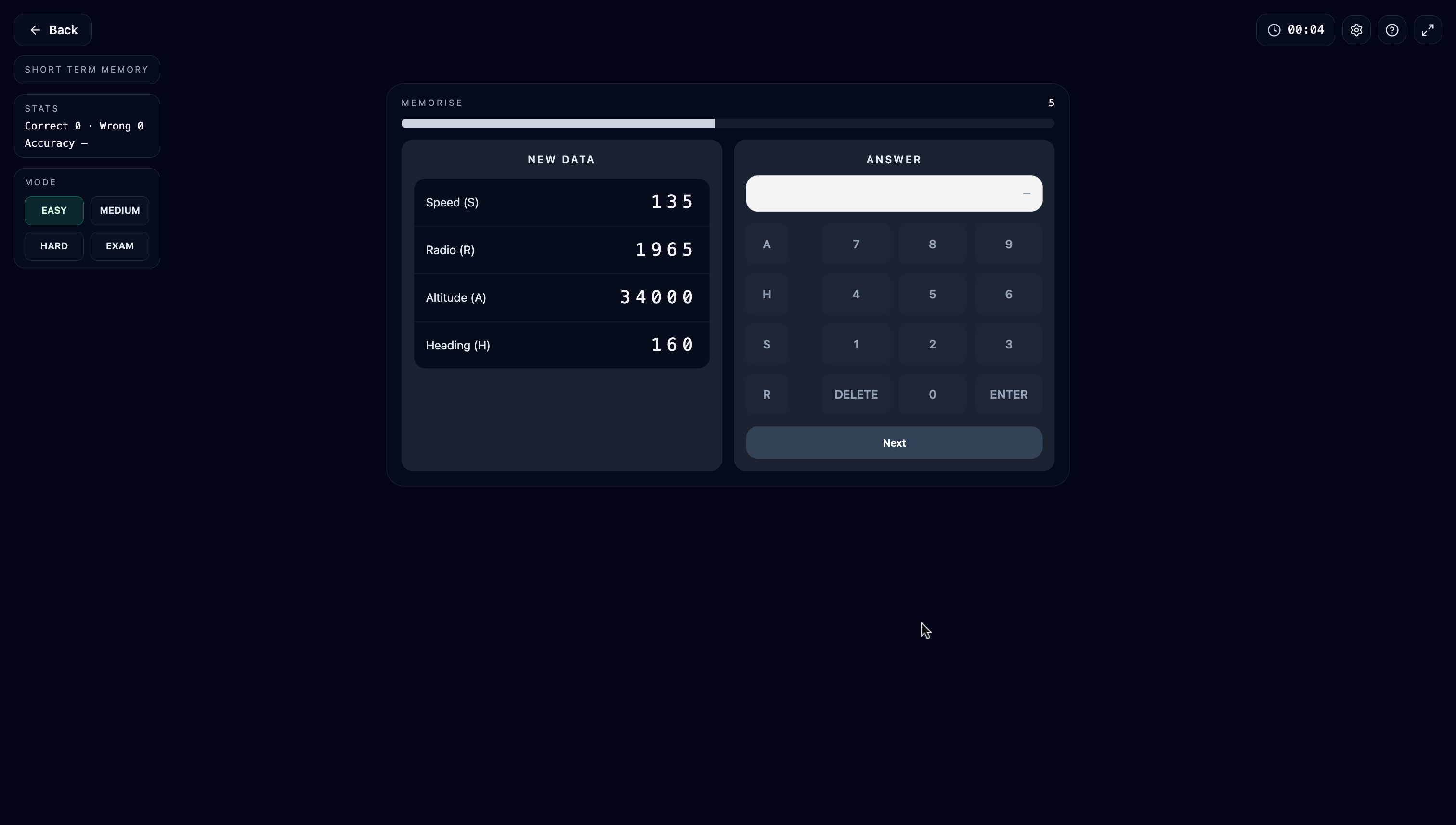
MEMORISE: memorise four values
Each round shows four instrument values: Altitude (A), Heading (H), Speed (S) and Radio (R). The order is shuffled every round — it is not always A→H→S→R. The default memorise window is 10 seconds.
REPRODUCE: re-enter the blanked fields
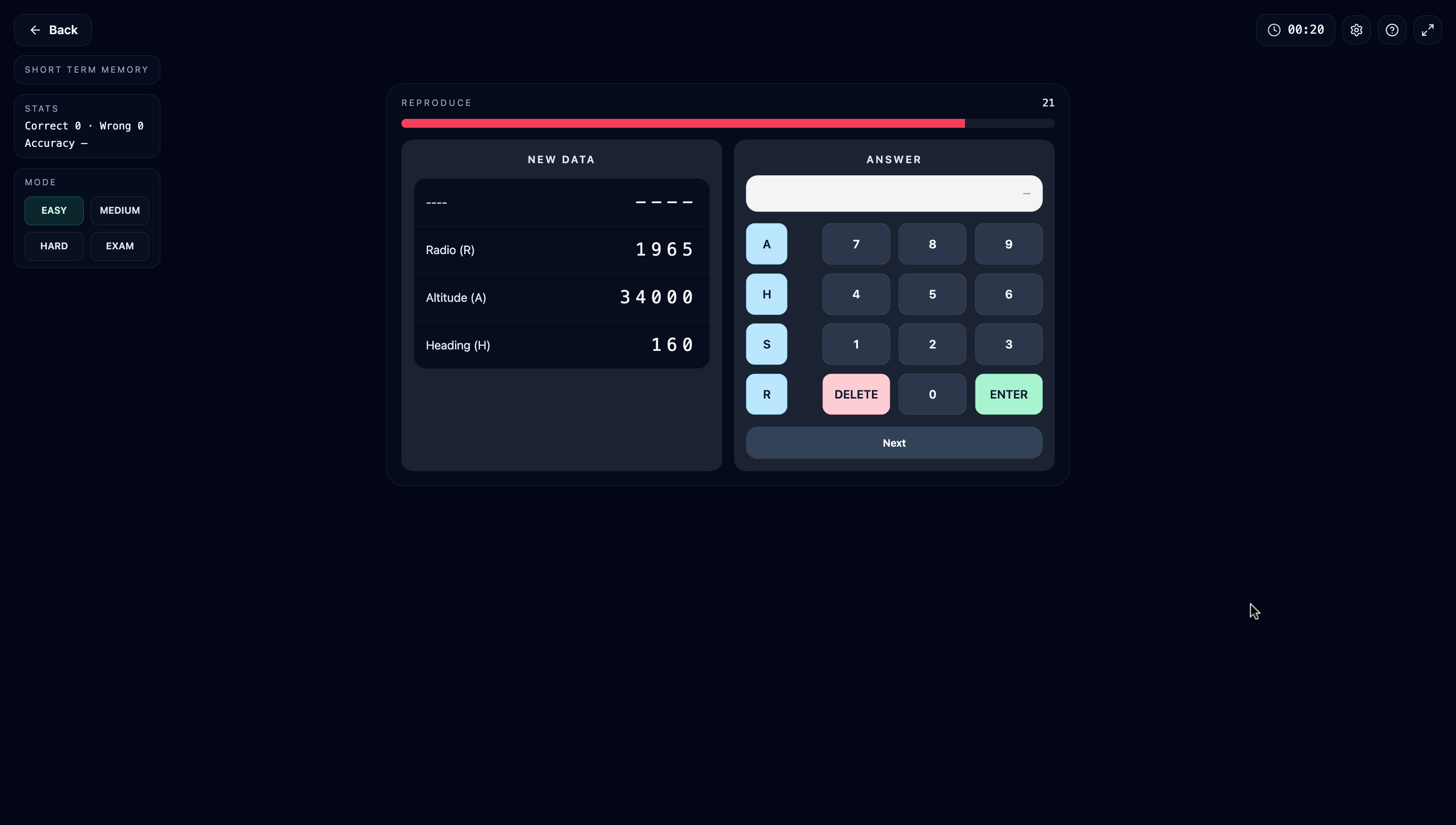
One to four of the values turn into "----". You re-enter only the blanked ones in NUMBER-THEN-LETTER format: for Speed 340 you type "340S" and press Enter. The keyboard (0–9 and A/H/S/R) works, as does the on-screen keypad.
Field-by-field grading
When the round locks, every field is graded separately: a field is correct only when both the letter and the value are right. Unfilled blanks count as wrong. The score is correct fields over all blanked fields.
Round schedule and timing
The REPRODUCE window is fixed per mode: 24 seconds on Warm-up, 20 on Standard, 15 on Advanced. Warm-up rounds mostly blank 1 field, Advanced rounds 3–4; Mock Exam is a 5-minute series climbing from 1 blank to 4.
How difficulty scales
Difficulty rises on two axes: how many fields are blanked (Warm-up 1–2, Standard 2–3, Advanced 3–4) and the answer window (24 → 20 → 15 s). On Advanced you hold nearly the whole set and unload it in order inside a tight window.
Top candidates encode values together with their letters ("340S, 15500A…") and never think about the format during entry; average candidates recall the number and improvise the letter — and since fields grade on both, that half-recall scores zero.