Control Task
This is the core tracking task; it asks you to protect the primary line while keeping attention and motor balance stable.
Why recruiters care about it
Control Task reveals a candidate’s flight-like tracking discipline in its rawest form.
Within Compass, the control backbone supporting other modules is read here.
Step-by-step simulation flow
Follow the flight director
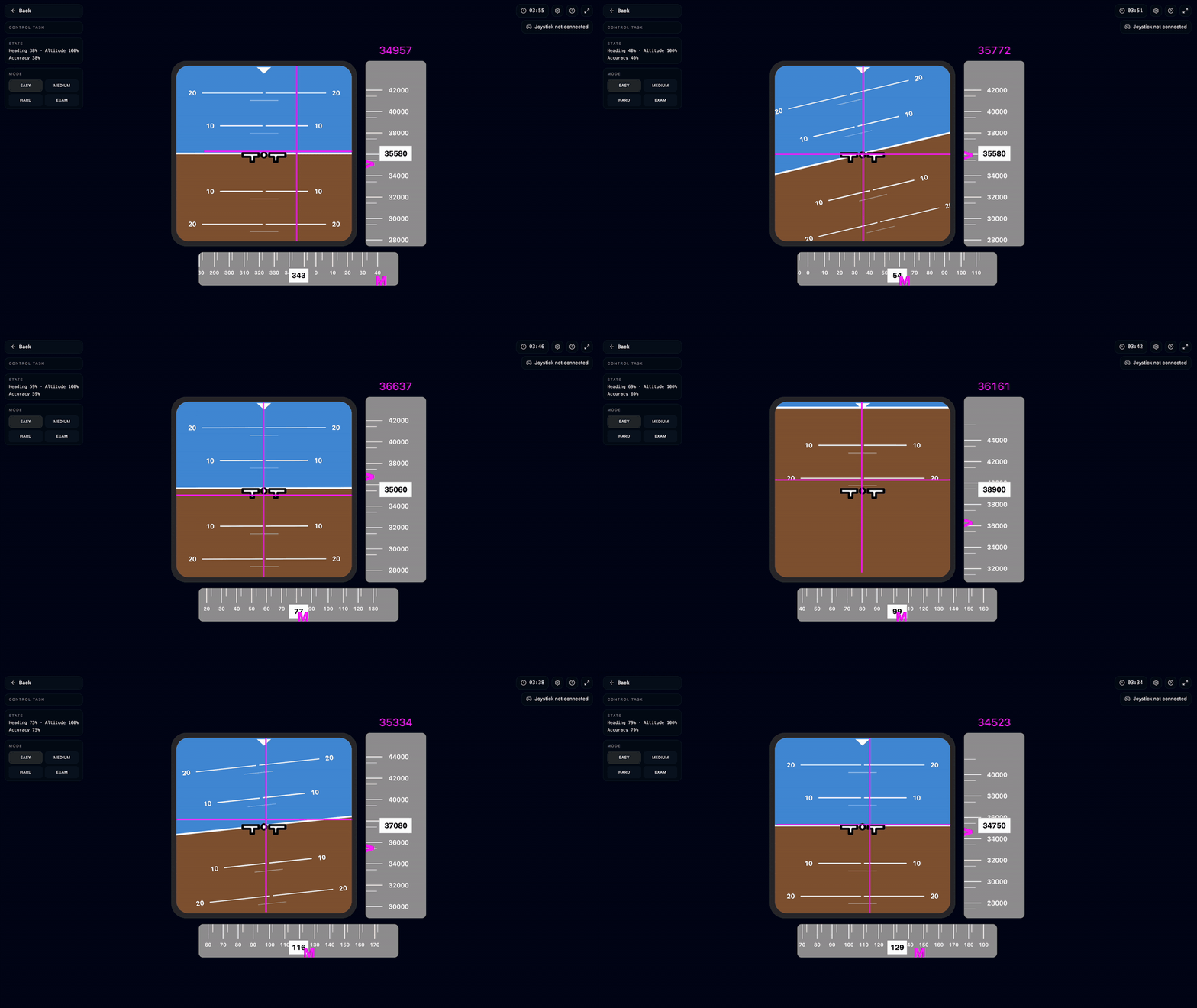
An attitude indicator sits in the centre, the altitude tape to its right and the heading tape below. Magenta targets (the "M" heading marker, the altitude caret and the flight-director lines) show where you must fly.
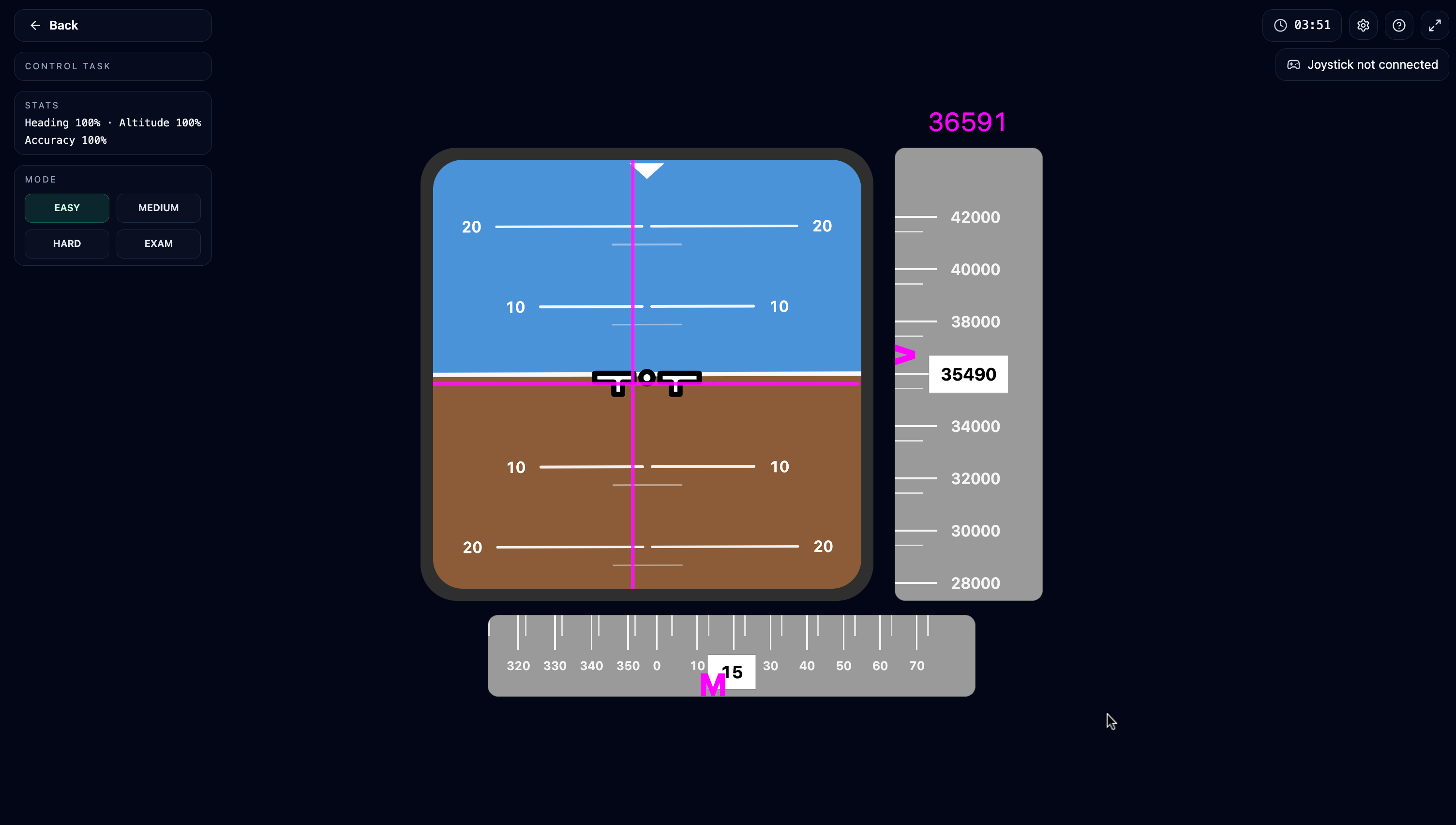
Heading through bank, altitude through pitch
Arrows ← / → bank the aircraft, and bank turns the heading; ↑ / ↓ pitch the nose, and pitch drives the altitude. Release the keys and bank/pitch decay back to zero — the aircraft responds with realistic inertia.
Chase the moving targets
The target heading and altitude never hold still: they drift at their own rates, flip direction every 10–20 seconds, and wind/turbulence modulate the drift. The task is holding both inside tolerance at once.
Scoring
The score is the share of the run with BOTH heading and altitude inside tolerance at the same time; the two sub-percentages (Heading / Altitude) are shown separately. A run lasts 4 minutes; Mock Exam hardens in 100-second blocks across 5.
How difficulty scales
Difficulty is a multiplier: Standard speeds target drift and turbulence by 10%, Advanced by 20%. The number looks small, but with two targets wandering independently the compound effect is very real.
Because the score demands the intersection ("both at once"), single-axis focus loses: 90% heading with 50% altitude collapses to a much lower joint score. Strong candidates carry both axes together with small corrections.