Numeracy — AON Cut-e digitChallenge
What this test measures
This section measures numerical processing speed and accuracy — mental arithmetic, number manipulation, and basic quantitative reasoning under time pressure.
Pilots constantly perform mental calculations: fuel figures, altitude conversions, time calculations, and descent planning.
How the simulation works
- 1
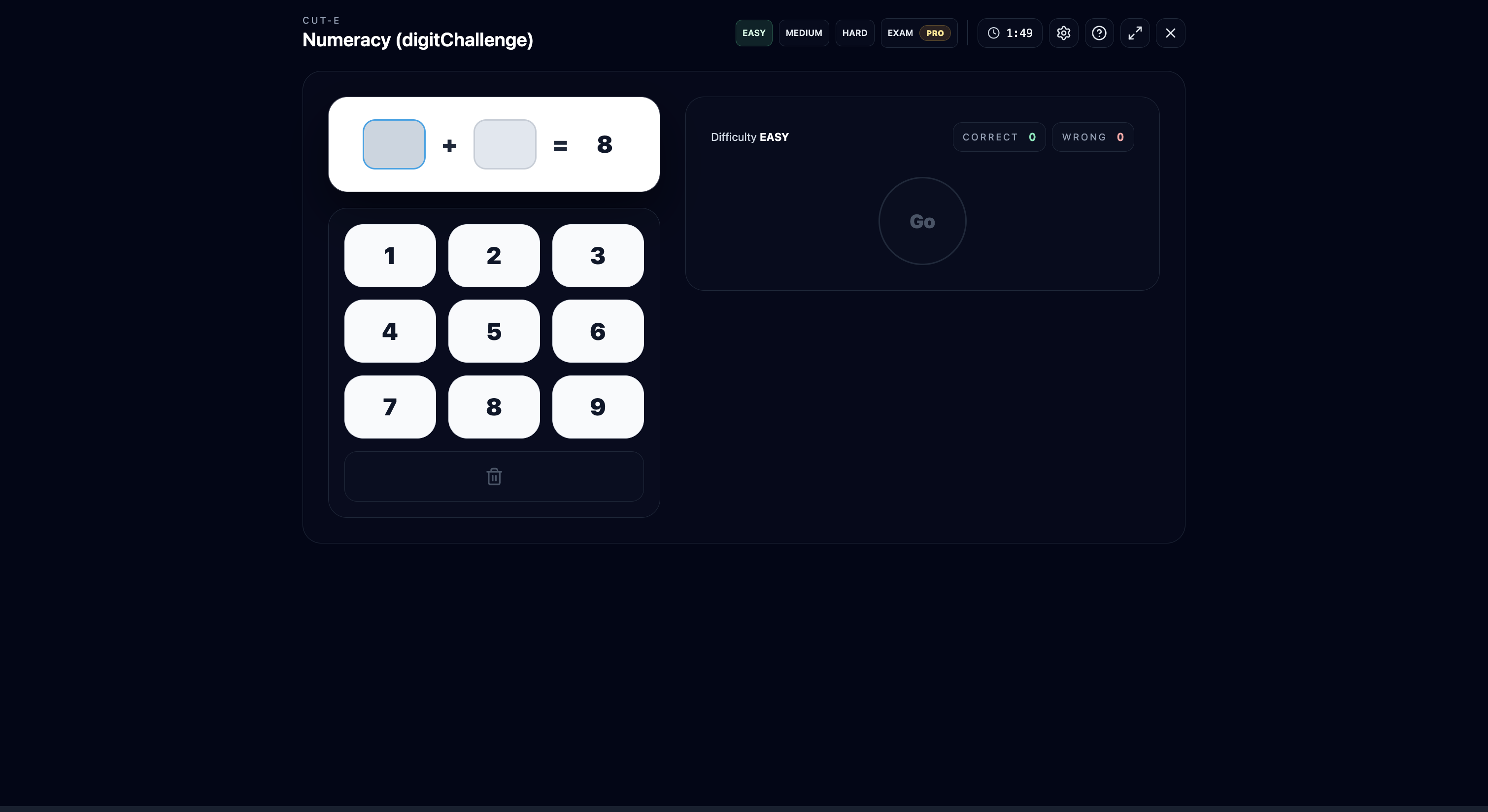
An equation with two blanks
Each question shows an operator (+, −, ×, ÷) and a target result, with two empty slots: "▢ + ▢ = 8". Your job is to fill both slots with digits from 1–9 so the equation is true.
- 2
Pick digits — no repeats
Tap a slot (the active one is outlined), then tap a digit on the 1–9 pad; the selection auto-advances from slot A to slot B. The same digit cannot be used twice in one question, and for − and ÷ the order matters: slot A is the first operand.
- 3
Submit with Go
Press the round Go button (or Enter) once both slots are filled. The card flashes green or red, and the next question appears immediately — the stream continues until the run timer expires.
- 4
Difficulty and scoring
Warm-up leans on addition and subtraction with small targets; Standard and Advanced shift the mix toward multiplication and division with larger results. The score is pure accuracy: correct answers over total attempts.
What it looks like
Tips for this test
- Lock slot A to the easiest anchor: for ÷ pick the divisor family first (result 4 → try 8÷2, 12÷3…), for − start from the larger digit.
- Multiplication targets are factor puzzles — knowing the times table cold is the single biggest speed gain.
- Remember the no-repeat rule: 4 + 4 = 8 is illegal; you need 3 + 5 or 1 + 7.
- Use Enter to submit instead of reaching for the Go button.
- Do not stall on an awkward pair — any valid combination scores the same, so take the first one you see.
Difficulty breakdown
The operator mix shifts from mostly addition and subtraction on Warm-up to multiplication and division dominating Advanced, with larger targets. Mock Exam ramps the mix automatically inside a single run.
Times-table automaticity decides the top end: candidates who see 24 as 3×8 without computing clear nearly twice the questions of those who calculate each pair.