Ability to Concentrate — AON Cut-e scales e3+
What this test measures
This section targets sustained attention and resistance to distraction. Candidates must detect specific target stimuli in a continuous stream of items while ignoring distractors.
It is critical for pilots who must maintain vigilance during long cruise segments and rapidly detect anomalies.
How the simulation works
- 1
One card, one decision
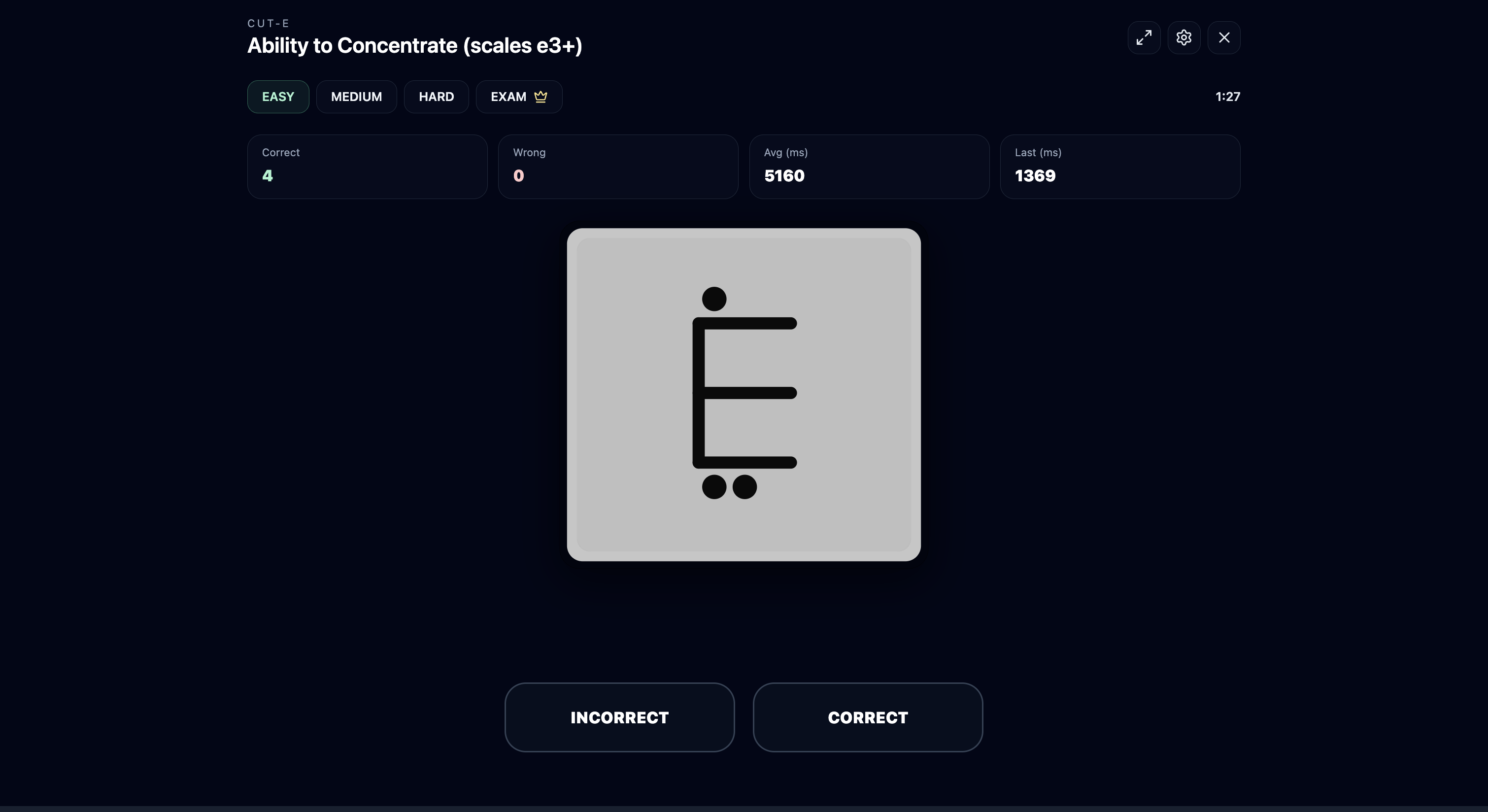
A single grey card appears with a letter-like figure and a number of black dots placed above and below it. You judge one thing: is the figure a proper capital "E" AND are there exactly 3 dots in total? If both are true press CORRECT (or the M key); if either fails press INCORRECT (or the Z key).
- 2
Count dots in total, not per side
Dots can sit above and below the figure in any split (2+1, 3+0, 1+2…). Only the total matters. Anything other than exactly 3 dots makes the item INCORRECT — even if the figure is a perfect E.
- 3
Watch for near-E shapes
On higher difficulties the wrong figures are no longer obviously different: you will see E-shapes with a missing bar, an extra stroke, or mirrored variants. The stream is fully self-paced — a new card appears the moment you answer — so the test becomes a race between careful checking and speed.
- 4
Scoring
Your score is pure accuracy: correct answers divided by total answers. Reaction times are tracked (average and last) so you can watch your speed improve, but a fast wrong press hurts more than a slightly slower correct one.
What it looks like
Tips for this test
- Check the shape first, then count the dots — a broken or mirrored figure lets you answer INCORRECT without counting at all.
- Count all dots together; splitting the count into "above" and "below" is the most common error.
- Use the keyboard (M = Correct, Z = Incorrect) — it is much faster than moving the mouse between buttons.
- Do not fall into a rhythm of automatic presses; the correct/incorrect mix is deliberately unpredictable.
- Train in short, fully focused blocks — this test measures sustained concentration, and sloppy long sessions train sloppy habits.
Difficulty breakdown
On Warm-up most wrong figures are obviously not an E, so shape-checking alone carries you. Standard and Advanced raise the share of near-E figures and of dot counts sitting at 2 or 4, which forces a genuine two-step check on every single card.
What separates top scorers is a fixed micro-routine — shape first, dot total second, answer — executed identically for minutes without drifting into rhythm-pressing. Accuracy above roughly 95% with a rising items-per-minute count is the profile to aim for.