Complex Control — AON Cut-e wingChallenge
What this test measures
Complex Control measures fine tracking control, coordination, and how smoothly you correct deviations under pressure.
For pilots, this maps closely to disciplined control inputs, avoiding overcorrection, and maintaining stable performance while workload rises.
How the simulation works
- 1
Fly through a tunnel of rotating shapes
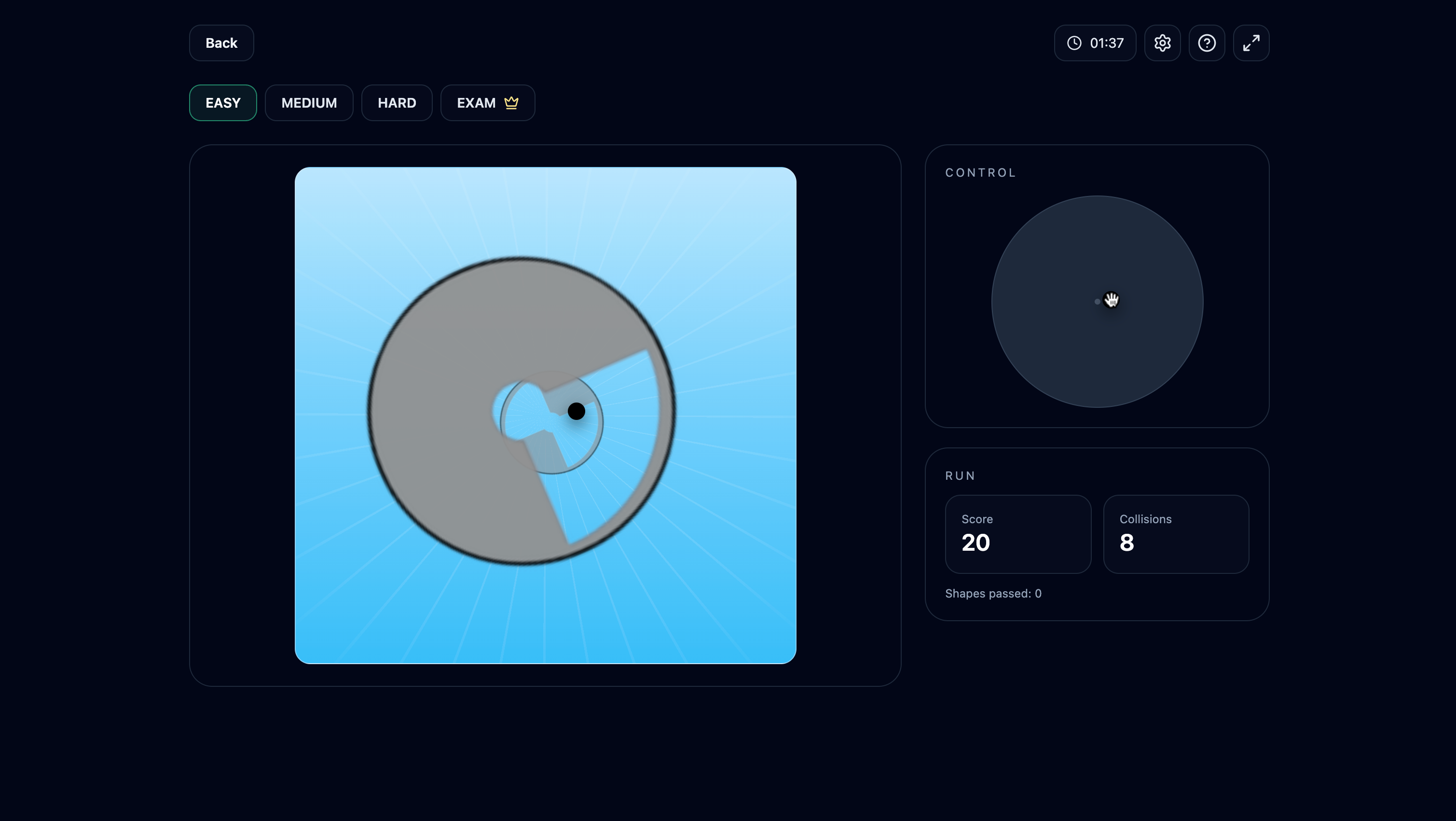
The viewport shows a tunnel: a large shape with cut-out gaps grows toward you while rotating, and the next shape is already visible behind it through the holes. A small black ball — your aircraft — sits wherever you steer it.
- 2
Steer with the control pad
You drag a knob inside a circular control pad; the ball in the tunnel mirrors your movement. The mapping is direct and continuous — small drags make small corrections, which is exactly what the task rewards.
- 3
Stay inside the gaps
As each shape reaches you, the ball must be inside one of its transparent gaps. On contact with a solid part the screen flashes red, the obstacle is pushed back and comes at you again — collisions cost time and points, but never end the run.
- 4
Difficulty and scoring
Higher levels speed up the tunnel and the rotation: a shape passes in roughly 10 seconds on Warm-up and under 7 on Advanced. The score starts from 100, loses 10 per collision, and earns a small bonus for every shape passed.
What it looks like
Tips for this test
- Make small corrections early instead of big saves late — the gap you need is visible seconds in advance.
- Watch the NEXT shape through the holes of the current one and pre-position for it.
- Rotation is the trap: aim where the gap WILL be when the shape reaches you, not where it is now.
- After a collision, reset calmly — the same obstacle returns, so use the replay to fix your line.
- Practise with a consistent grip and pad position; muscle-memory consistency beats bursts of speed.
Difficulty breakdown
Speed, rotation and post-collision setback all rise with difficulty: a shape that takes about 10 seconds to reach you on Warm-up arrives in under 7 on Advanced while spinning almost twice as fast.
The task punishes reactive steering. Top performers park the ball early where the gap will arrive and make only micro-corrections — collisions come from big late saves, not small early ones.