Multi-Tasking Capability — AON Cut-e falling obstacles
What this test measures
This simulation measures how well you can monitor and respond to multiple independent tasks under time pressure.
It is one of the most aviation-relevant tasks because pilots divide attention across instruments, radio, traffic, and procedures simultaneously.
How the simulation works
- 1
Three tasks share one screen
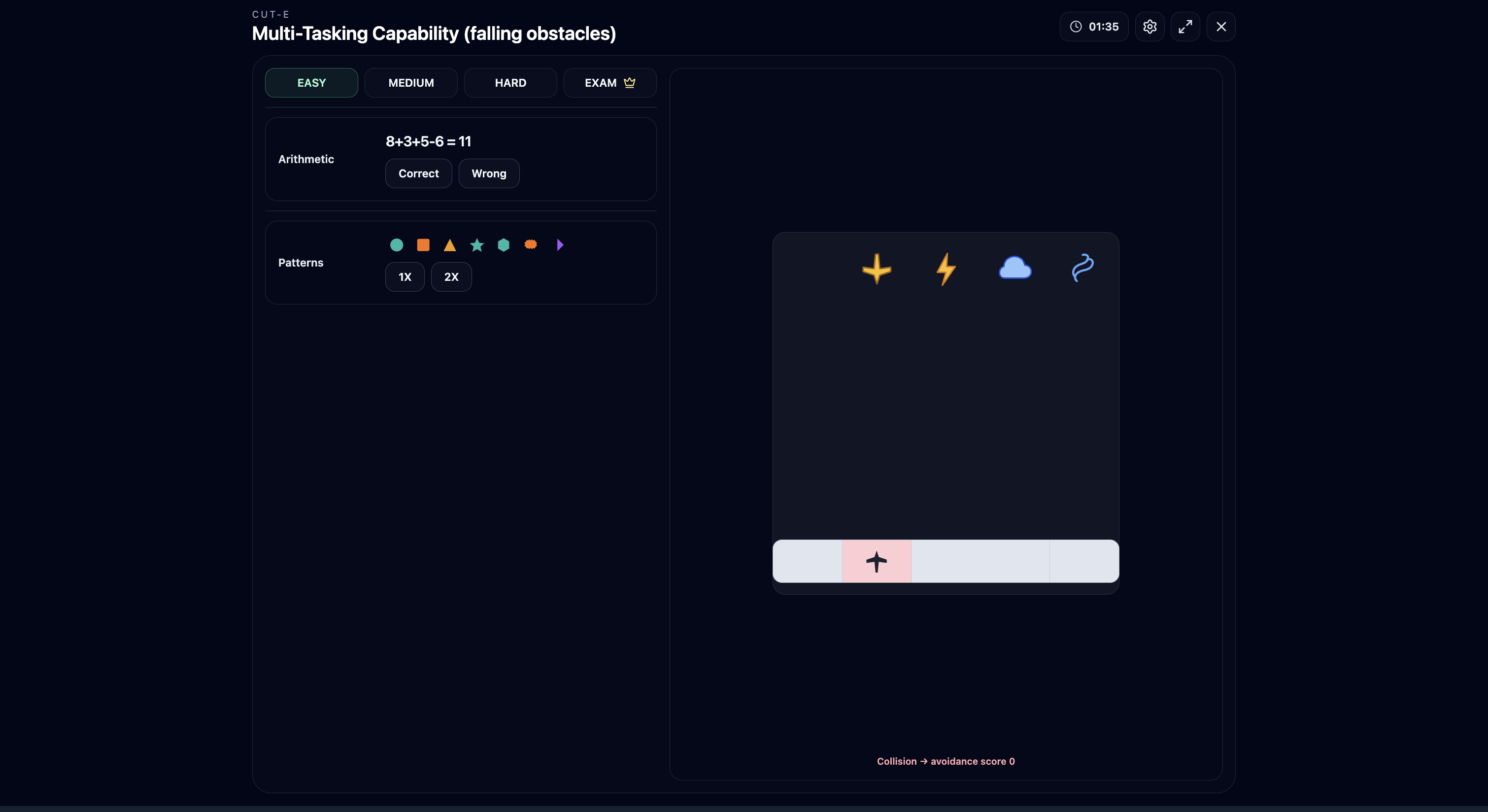
The left column holds an arithmetic check and a pattern check; the right column is an obstacle field with a small aircraft at the bottom. All three run at the same time — nothing pauses while you handle something else.
- 2
Arithmetic: verify the shown result
A chain like "8+3+5−6 = 11" appears with a result already filled in. Decide whether it is right and press Correct or Wrong — about half the items are deliberately off by a small amount. A new item appears the moment you answer.
- 3
Patterns: 1X or 2X
Seven coloured symbols are shown in a row. If every shape+colour combination is unique press 1X; if any symbol appears twice press 2X. Like the arithmetic, it is self-paced and regenerates instantly.
- 4
Obstacles: steer to the free lane
Waves of four obstacles fall across five lanes — exactly one lane is always free. Move the aircraft with the ← → arrow keys into the free lane before the wave lands. A collision does not end the run, but it zeroes the avoidance component of your score.
- 5
Scoring
The combined score weighs arithmetic accuracy 40%, pattern accuracy 30% and obstacle avoidance 30%. On your first visit an in-game coach walks you through all three tasks one by one before the clock starts.
What it looks like
Tips for this test
- Make the obstacle field your anchor: glance at each new wave FIRST, move to the free lane, then spend the fall time on arithmetic and patterns.
- Verify the whole arithmetic chain quickly rather than trusting the last number — errors are hidden anywhere in the sum.
- For patterns, scan for duplicates and stop at the first hit; confirming uniqueness needs a full pass, spotting a repeat does not.
- One collision costs the entire 30% avoidance component — protecting the plane beats one extra arithmetic answer every time.
- Keep your hands split: arrows on the keyboard for the plane, mouse on the two answer panels.
Difficulty breakdown
Higher levels drop obstacles roughly twice as fast, lengthen the arithmetic chains and raise the duplicate probability in the patterns — squeezing the time you can safely spend away from the obstacle field.
The score structure makes prioritisation the skill: a single collision zeroes the 30% avoidance component, so top candidates never trade the plane for one more answer — and still keep both accuracies high by working during the fall time.