Inductive Reasoning — AON Cut-e scales ix
What this test measures
This section measures inductive reasoning in a visual / abstract classification format — classifying new items based on inferred rules.
Compared with cls/clx, scales ix often focuses more on classification and generalisation rather than sequence completion.
How the simulation works
- 1
Nine objects, one intruder
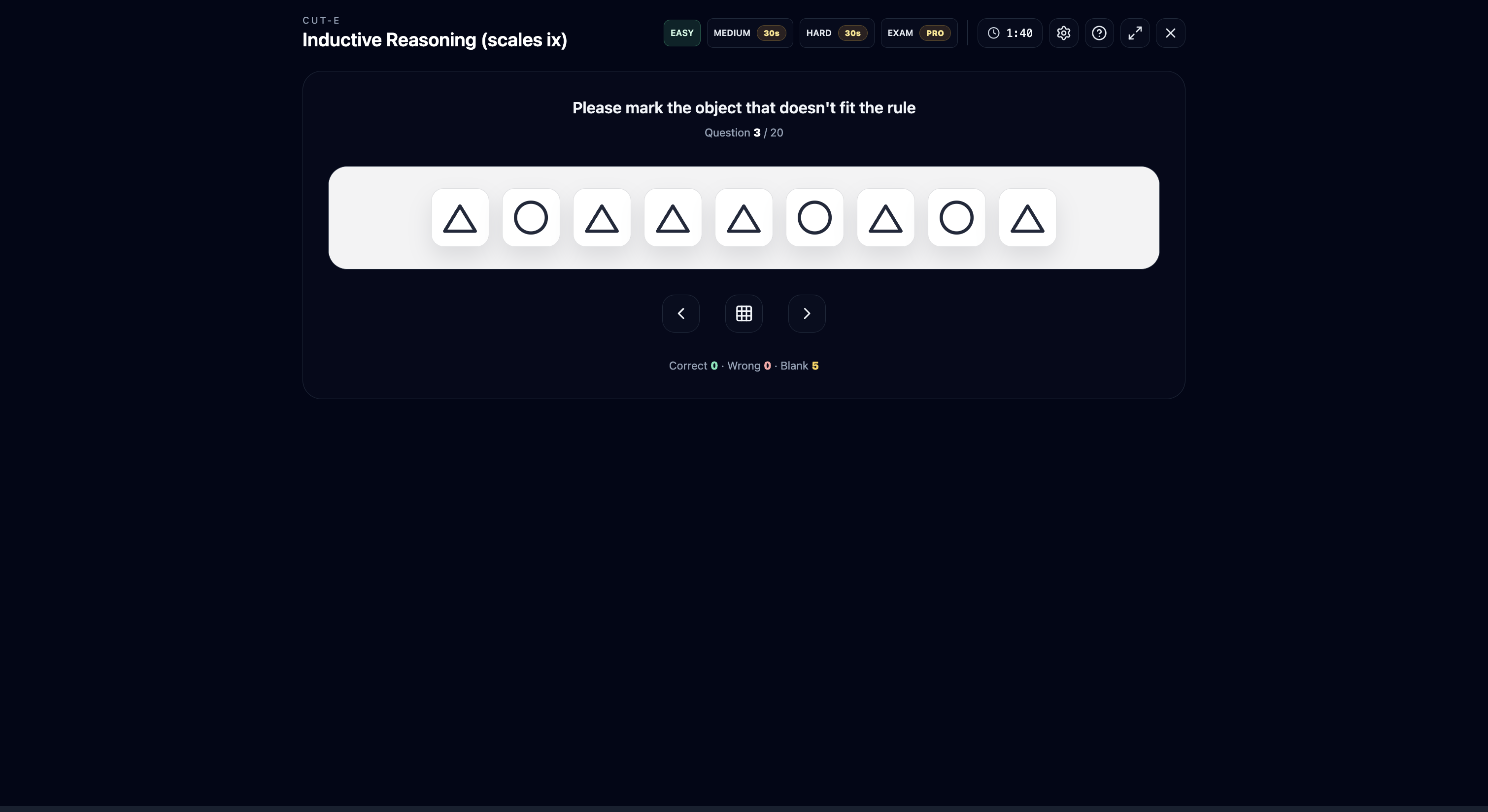
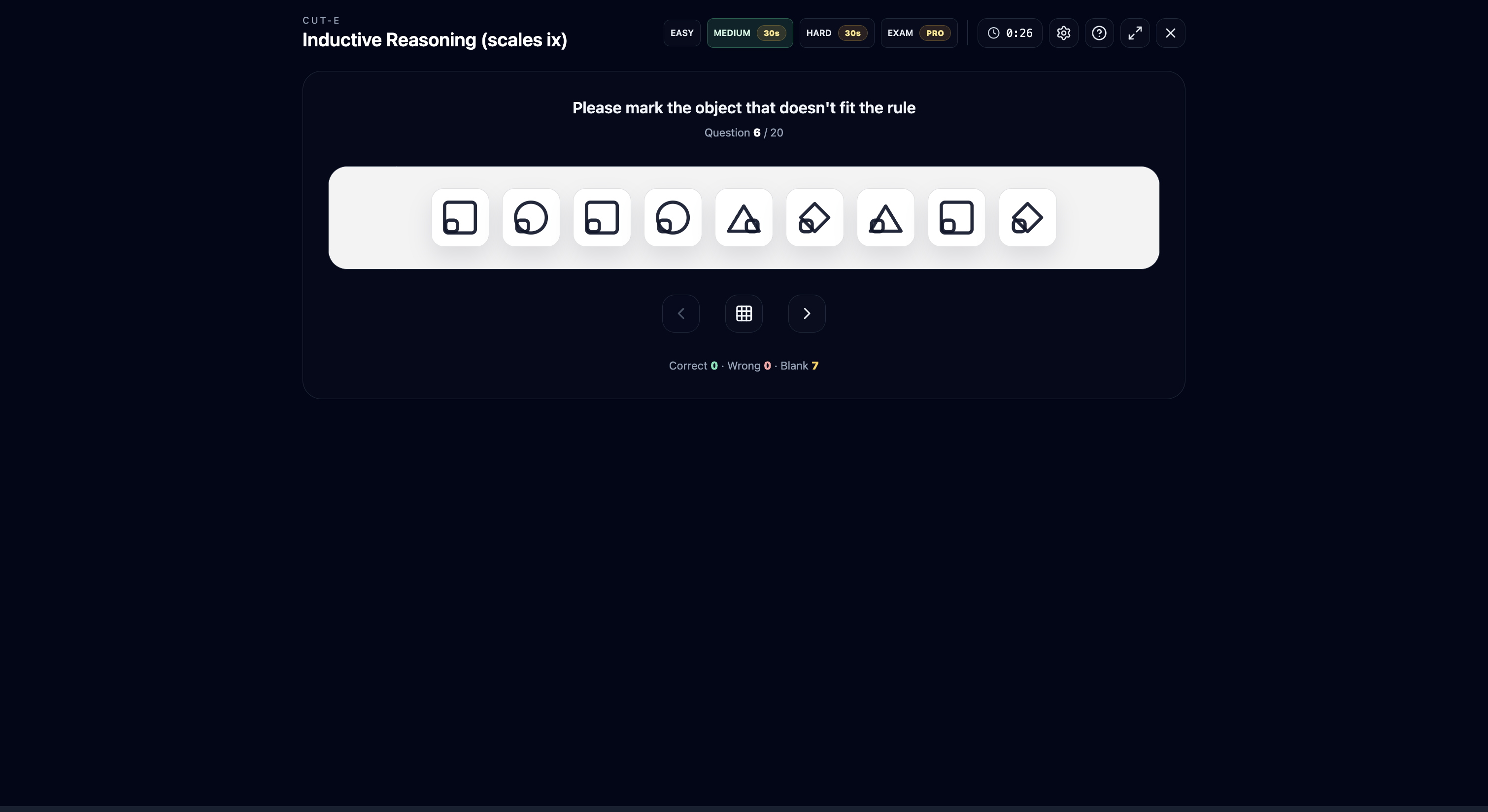
Each question shows a row of nine figures that all follow one hidden rule — alternating shapes, a rotating glyph, a repeating dot-count cycle, a fixed inner-corner position — except for exactly one figure that breaks it. The prompt is always the same: "Please mark the object that doesn't fit the rule."
- 2
Tap the odd one out — instant feedback
Click the figure you believe breaks the rule. It turns green when right (with the rule spelled out, e.g. "Shapes alternate A-B-A-B…") or red when wrong. There is no submit step, and you can revisit and change answers freely with Previous/Next or the jump grid.
- 3
20 questions in three bands
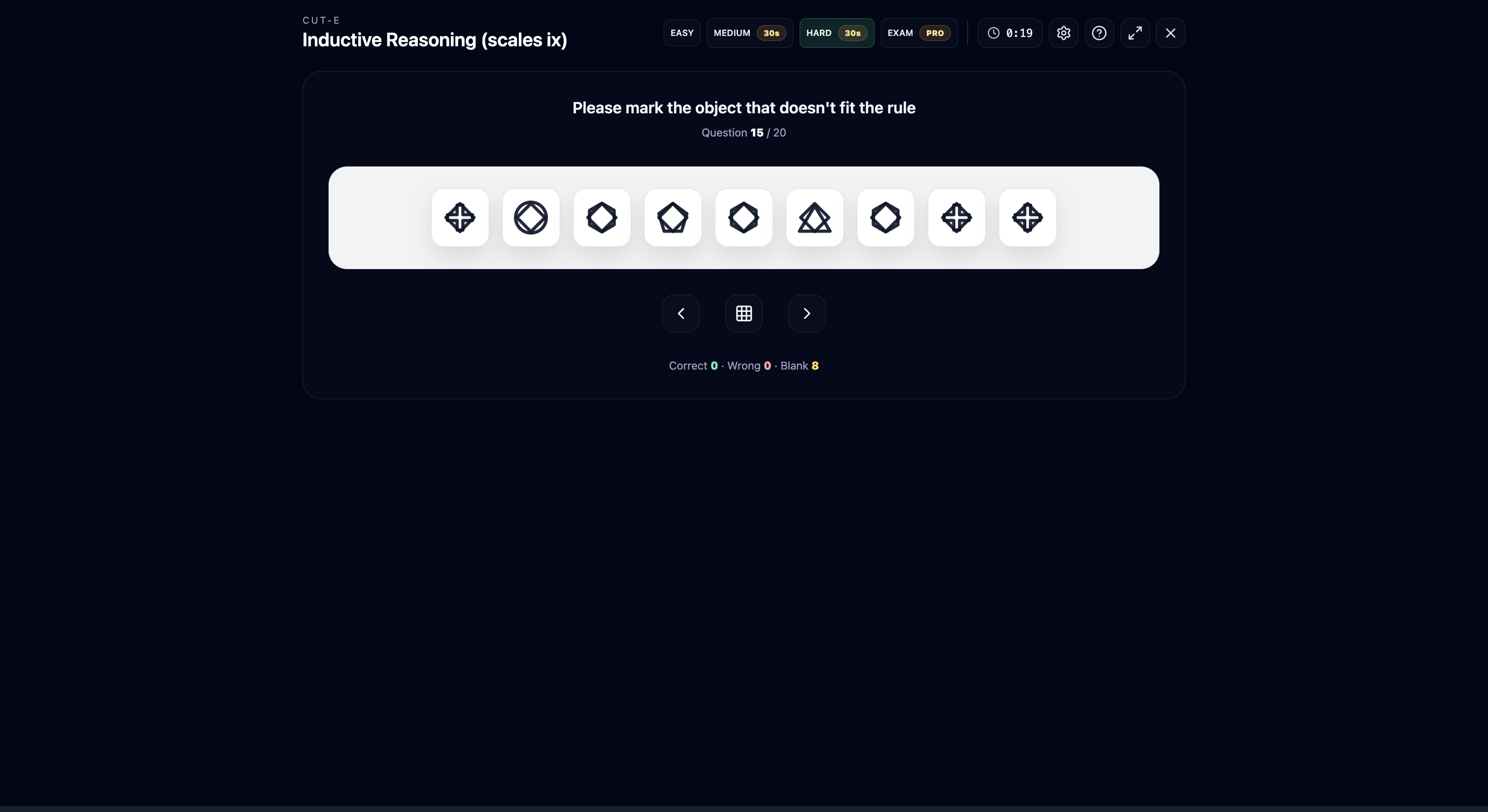
A run holds 20 pre-generated questions: 1–5 Warm-up (alternations, rotations, bar counts), 6–12 Standard (nested positions, dot cycles, dashed outlines), 13–20 Advanced (subtle near-identical variants). Your selected difficulty unlocks its band; Mock Exam opens all 20.
- 4
Scoring
The score is correct answers over ALL questions in the active band — unanswered questions count against you, so it pays to attempt everything before the timer runs out.
What it looks like
Tips for this test
- Guess the rule from the first three figures, then verify it on two more positions before hunting the intruder.
- Check one property at a time: shape family first, then rotation, then counts. Mixing two rules is the classic error.
- Sequences can cycle — a 1→2→3 dot pattern restarting at 1 is not a break.
- On Advanced, differences shrink to a single stroke or corner; compare neighbouring figures pairwise instead of scanning the whole row.
- Blanks cost as much as wrong answers here — commit to your best candidate on every question.
Difficulty breakdown
The bands step up from obvious alternations to near-identical composite glyphs where a single stroke breaks the rule. Because blanks count against you, the clock is the real opponent on Advanced.
The difference between average and top scores is rule isolation: checking one property at a time instead of trying to 'see' the odd one out — intuition works on Warm-up and fails exactly where the points are.