Inductive-logical Thinking — AON Cut-e scales cls
What this test measures
This section measures your ability to identify patterns and rules from examples and apply them to new cases.
Pilots use inductive thinking to diagnose system malfunctions, interpret unusual instrument readings, and build mental models from incomplete information.
How the simulation works
- 1
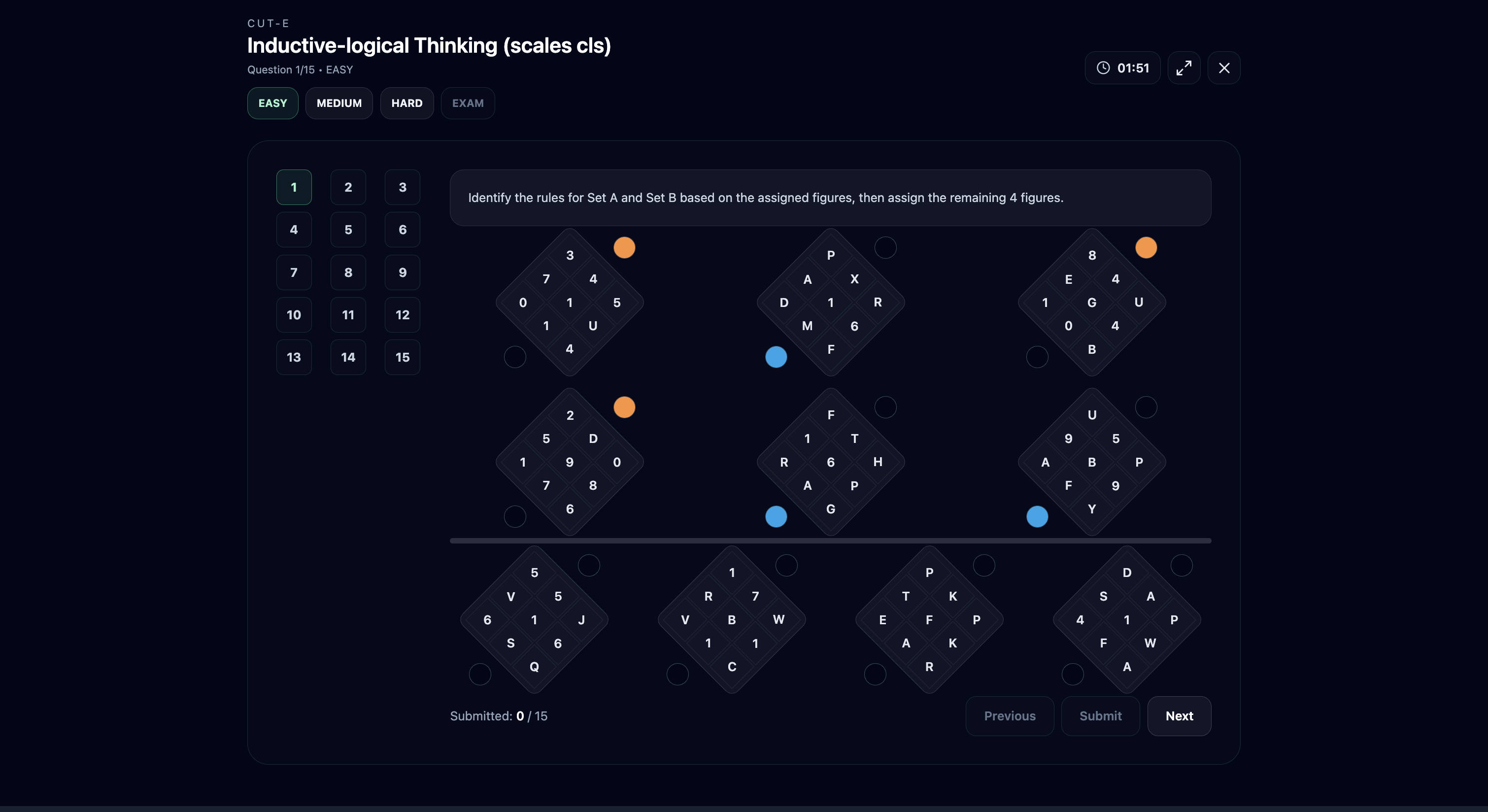
Six classified figures, two hidden rules
Each question shows six diamond-shaped 3×3 letter/number grids that are already classified: orange dot = Set A, blue dot = Set B. One hidden rule defines Set A (for example "exactly two T, both in corners") and a different rule defines Set B (for example "exactly three 9 anywhere").
- 2
Infer both rules
Compare the three A-figures with each other and find what they share; do the same for B. Rules are about counts and positions of symbols: "exactly N of a symbol", "two T in the corners", "contains K, M and R", "all digits odd", "all digits ≥ 6", "at least 5 digits".
- 3
Classify the four unassigned figures
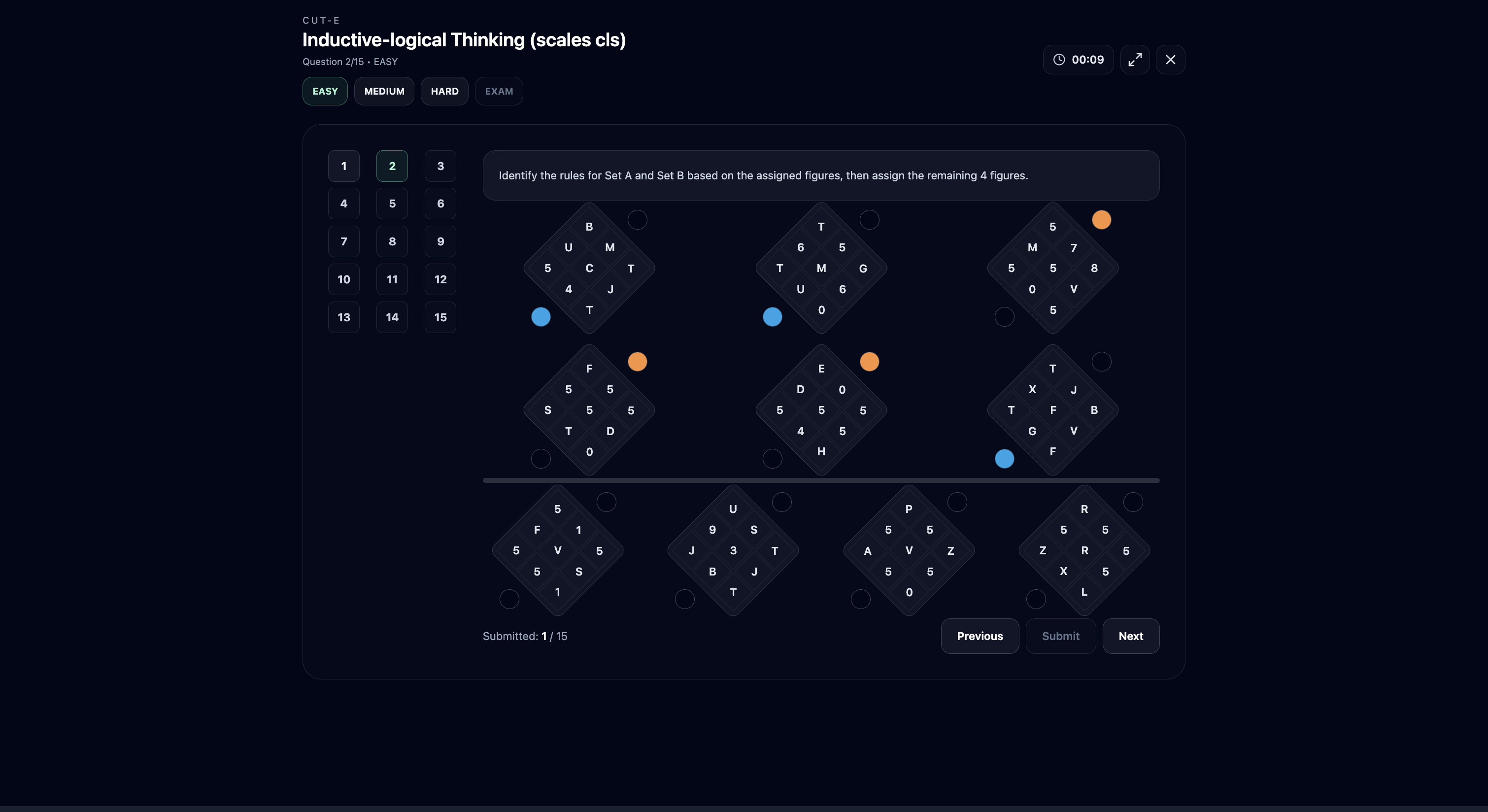
Below the divider, four new figures wait. Tag each one A or B with its toggle pills — every figure satisfies exactly one of the two rules. Submit unlocks only when all four are assigned.
- 4
Instant reveal and free navigation
On submit, each of your four assignments is graded green/red, matching cells are highlighted, and both rules are revealed in plain words. The run has 15 questions — questions 1–5 are Warm-up, 6–10 Standard, 11–15 Advanced — and you can navigate freely with the numbered sidebar.
What it looks like
Tips for this test
- Start with the most "visual" hypothesis: repeated letters and corner positions are faster to spot than digit properties.
- A rule must hold for ALL three figures of its set — one counter-example kills the hypothesis immediately.
- Corners mean the four outer vertices of the rotated grid, not the mid-edges; this is the classic trap.
- When you have found rule A, do not force rule B to be similar — the two rules are usually different in kind (one positional, one count-based).
- Check unassigned figures against ONE rule only; if it fails A it must be B — every figure fits exactly one set.
- Blank questions score nothing: an educated 4-figure assignment is always better than skipping.
Difficulty breakdown
All fifteen questions draw from the same rule families; the pressure comes from the clock and the band you are in (1–5 Warm-up, 6–10 Standard, 11–15 Advanced). The real difficulty is hypothesis discipline — dropping a rule the moment one figure contradicts it.
Top performers run a fixed checklist (repeated symbols → corners → digit properties) and test each unassigned figure against a single rule only, which roughly halves the time per question.