Spatial Orientation — AON Cut-e scales ndb
What this test measures
This section measures your ability to perceive, maintain, and manipulate spatial relationships — including mental rotation and maintaining orientation during simulated movement.
It is critical for instrument flying, 3D situational awareness, and unusual attitude recovery where you must stay oriented without visual references.
How the simulation works
- 1
Read the two instruments
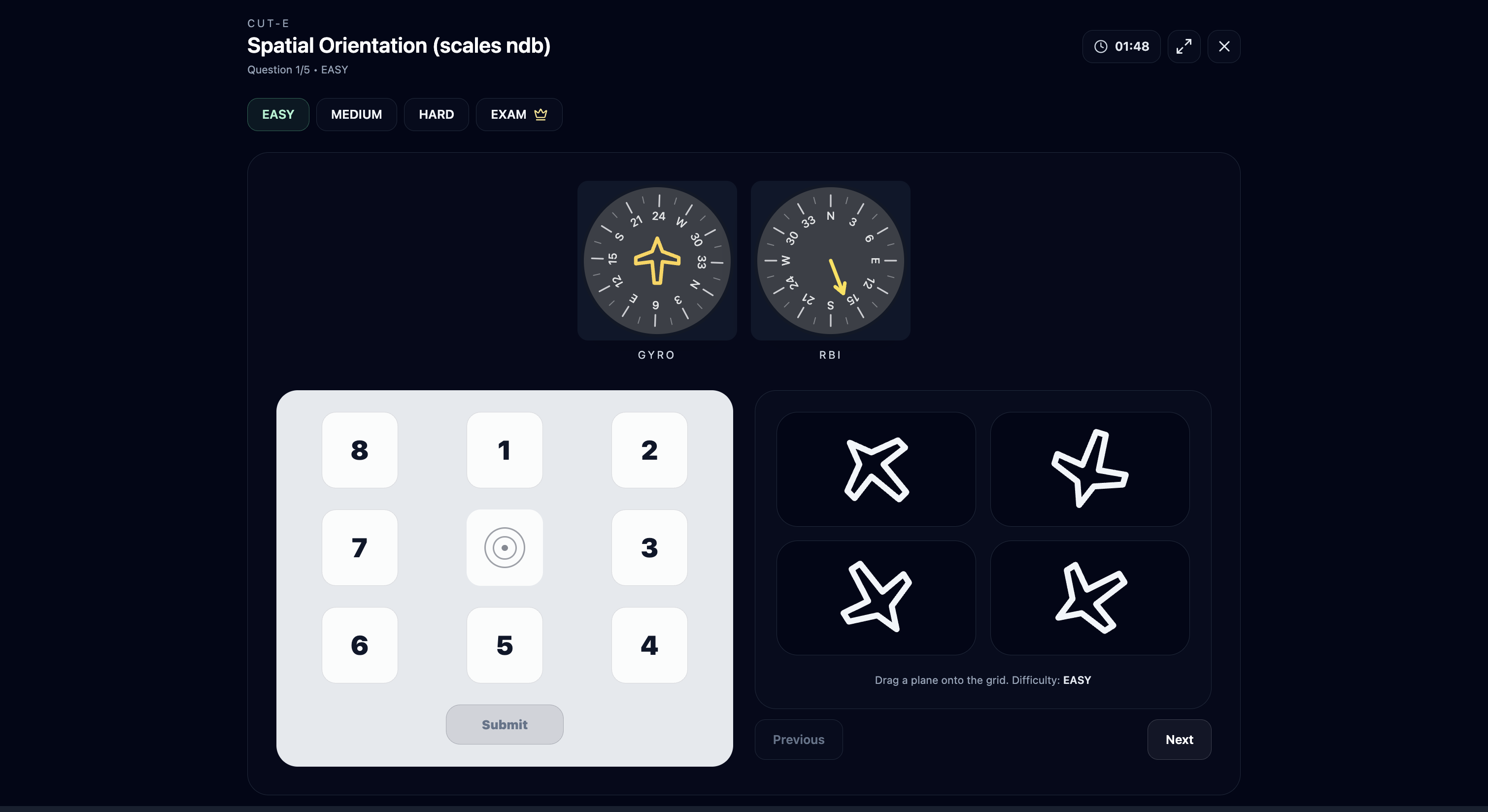
Each question shows two dials. The GYRO has a rotating compass card with a fixed yellow aircraft — it tells you the aircraft heading. The RBI has a fixed card with a rotating needle — it points to where the target is relative to the aircraft nose. RBI directions are rounded to the nearest 45°.
- 2
Pick the aircraft that matches the GYRO heading
Four aircraft silhouettes point in different directions. Select the one whose nose matches the GYRO heading. On EASY the wrong options point clearly elsewhere; on HARD two of them are within 20° of the correct heading.
- 3
Place it on the grid around the target
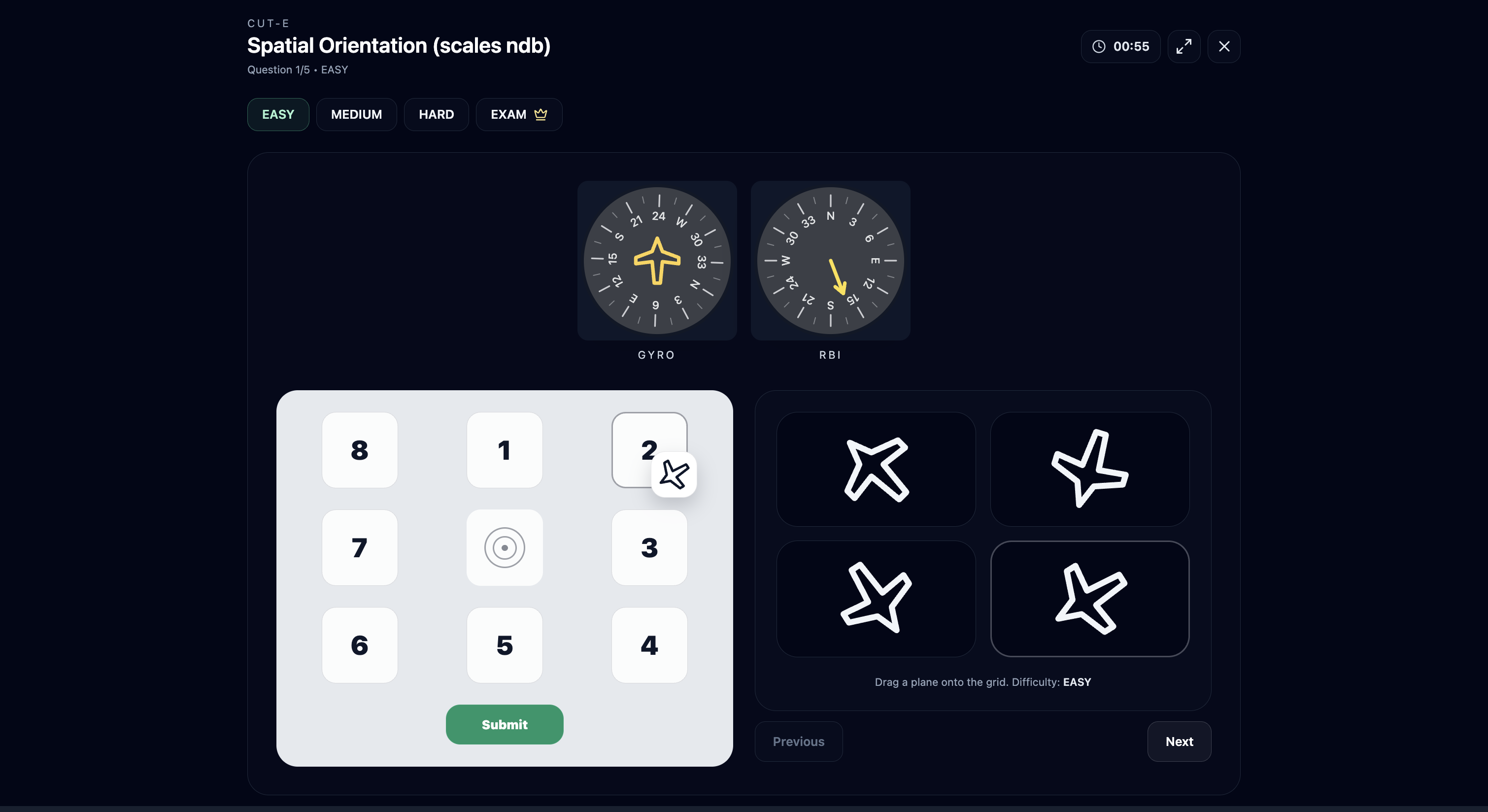
The target is always the centre of the 3×3 grid. Work out where the aircraft must sit so that, looking from its nose, the target lies in the RBI direction — then drag the chosen aircraft onto that numbered cell (N=1, NE=2 … NW=8). You can reposition it or press Clear before committing.
- 4
Submit and review
Submit locks the question and shows the correct aircraft and cell in green (a wrong pick turns red). Both the aircraft AND the cell must be right for the question to count. Previous/Next lets you review answered questions or move on.
What it looks like
Tips for this test
- Solve in a fixed order every time: GYRO heading first, RBI direction second, position third. Routine kills panic.
- Remember the placement logic: the aircraft sits OPPOSITE the direction in which it sees the target — if the target is north-east of the aircraft, the aircraft is south-west of the target.
- Use the RBI needle direction, not the numbers printed on its card.
- On HARD compare the near-identical aircraft options against a clock face ("heading ~60° vs ~80°") before choosing.
- The centre of the grid is always the target; never place the aircraft in the centre.
Difficulty breakdown
The difficulty lives in the answer options: on EASY the wrong aircraft point far away from the GYRO heading, while on HARD two distractors sit within about 20° of the correct one — forcing precise dial reading instead of rough matching.
High scorers run an automated routine (heading → bearing → opposite placement). Once that routine is reflexive, HARD costs only a second or two more per question than EASY.