Monitoring — AON Cut-e monitoring
What this test measures
Monitoring measures sustained scan quality, anomaly detection, and how quickly you notice a critical change without overreacting to noise.
For pilot candidates this matters because cockpit performance depends on detecting subtle state changes while staying calm and systematic.
How the simulation works
- 1
Dots in constant motion
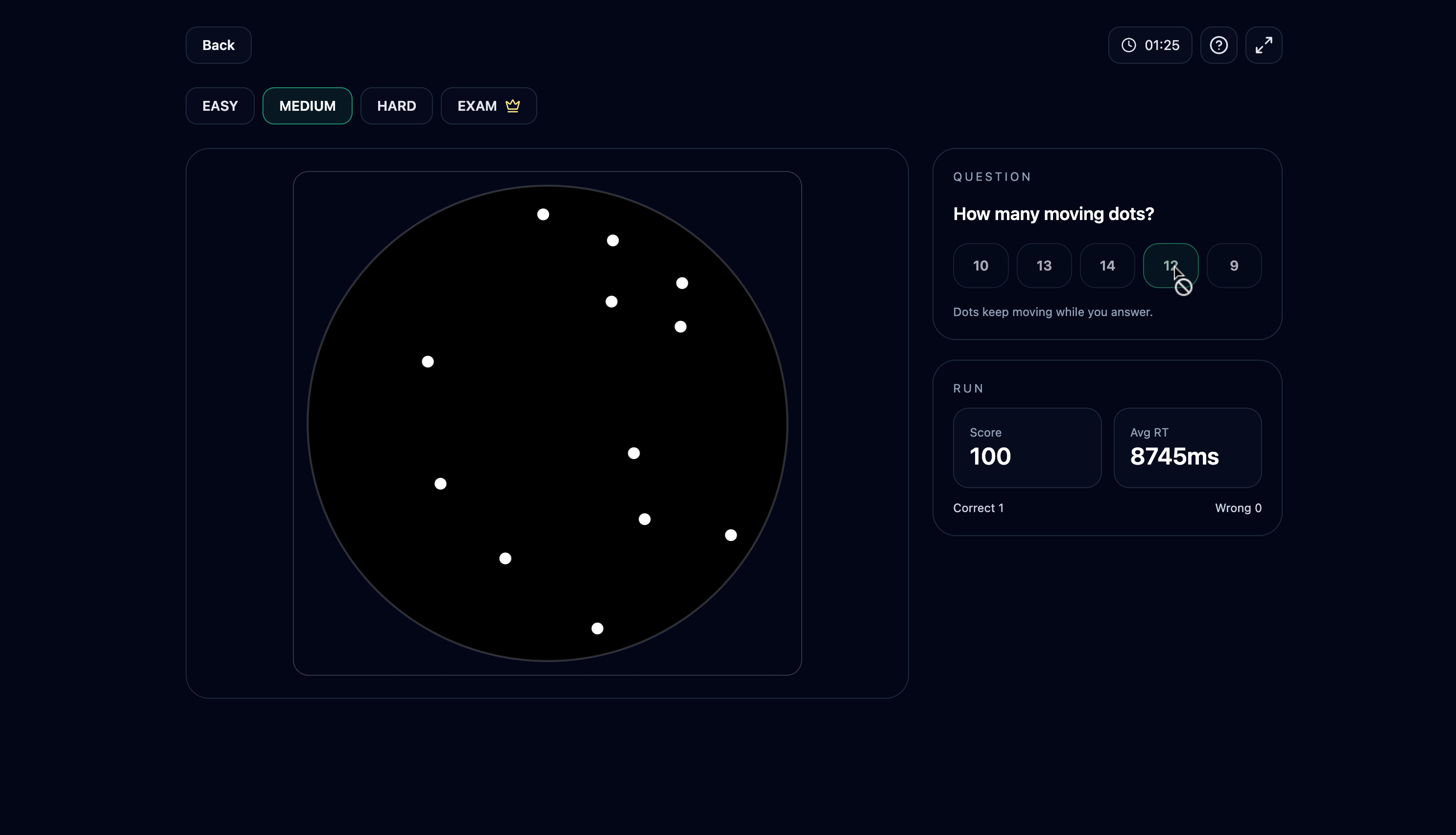
A black circular arena contains a number of white dots bouncing continuously off the walls. They never stop — not even while you are answering.
- 2
Count them — while they move
The question is always "How many moving dots?". Five numeric options are offered: the true count plus four close distractors (±1 to ±3). Pick the exact number.
- 3
Instant feedback, endless rounds
Your answer flashes green or red, and after a moment a fresh round starts with a new count, new positions and new velocities. Rounds continue until the run timer expires.
- 4
Difficulty and scoring
EASY runs 8–12 slow dots; HARD runs 14–20 fast ones. The score is pure accuracy (correct ÷ answered), with your average reaction time reported separately.
What it looks like
Tips for this test
- Count in spatial clusters (top arc, centre, bottom arc) instead of chasing individual dots with your eyes.
- Use a fast grouping count — pairs or triples — rather than one-by-one enumeration; the dots will not hold still for a slow count.
- Commit within a few seconds: the longer you stare, the more the motion scrambles your partial count.
- If two counts feel possible, recount only the region you are unsure about, not the whole arena.
- Accuracy drives the score, but train speed too — the real test rewards quick, confident counts.
Difficulty breakdown
Dot count and speed climb together: 8–12 slow dots on EASY become 14–20 fast ones on HARD, and the wrong options always sit within ±3 of the truth, so estimation never suffices.
High scorers cluster-count within the first seconds and commit; long counts fail because the scene keeps rearranging itself while you stare.