Inductive Logical Reasoning — AON Cut-e scales clx
What this test measures
This section measures advanced inductive reasoning with complex, multi-layered rules. It is generally more demanding than cls because rules operate on multiple dimensions simultaneously.
It tests systematic analytical thinking that is useful for troubleshooting complex aircraft systems and building accurate mental models under time pressure.
How the simulation works
- 1
Learn the rule from the example pair
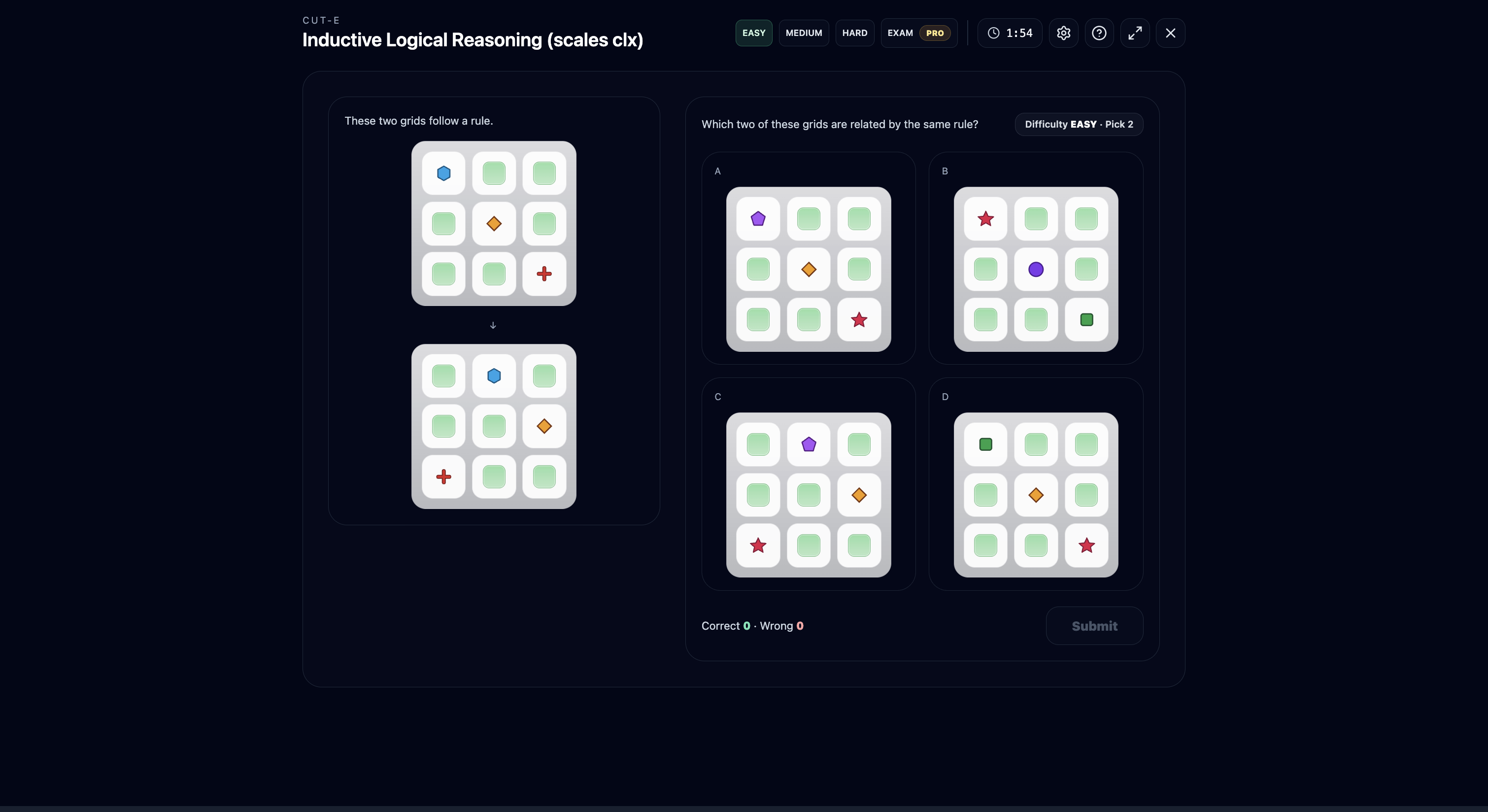
On the left, two 3×3 shape grids are shown one above the other: the bottom grid is the top grid after ONE transformation — a mirror, a rotation, a wrap-around shift, a transpose, or (on HARD) a combination of two.
- 2
Find the pair that follows the same rule
On the right, four grids labelled A–D are shown. Exactly two of them are related by the same transformation as the example. Select those two — your picks get numbered badges, and tapping again deselects.
- 3
Submit and read the revealed rule
Submit locks the answer: the correct pair turns green, wrong picks turn red, and the rule is spelled out in plain English ("Rotate 90° clockwise", "Shift every cell one step right (wrap)"). Questions stream one after another until the timer ends.
- 4
Difficulty and scoring
EASY uses single mirrors, 180° rotations and shifts on sparse grids; MEDIUM adds 90° rotations and transposes; HARD combines two operations on fully-filled grids. Score is the share of questions where you found the exact pair.
What it looks like
Tips for this test
- Verify hypotheses with corners and the centre — they are the fastest cells to check for any mirror/rotation/transpose.
- One or two shapes are enough to confirm a rule; checking all nine wastes the clock.
- If corners do not match after your candidate transformation, eliminate that hypothesis instantly.
- Remember wrap-around: in shift rules, the shape leaving the edge re-enters on the opposite side.
- Transpose and rotation get confused most — transpose keeps the main diagonal fixed, rotation does not.
- Both picks must be right. If you are only sure of one grid, hunt its partner rather than pairing it with a guess.
Difficulty breakdown
EASY uses single transformations on sparse grids; MEDIUM adds 90° rotations and transposes; HARD fills all nine cells and chains two operations, which defeats naive whole-grid comparison.
Strong candidates verify with corners and the centre only, and eliminate hypotheses aggressively — the pair is usually found by disproving options rather than proving one.